58 of 250 stories
A Colorful Life
16 reads
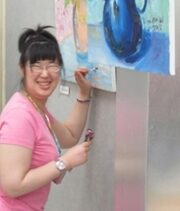
When Lisa was born, we were told what she would probably never be able to do.
She had suffered severe oxygen deprivation during birth, leaving significant brain damage and cerebral palsy. The doctors' predictions were devastating. She might never walk. She might never speak. Her disabilities would be severe. We were even advised not to pursue too much treatment.
For parents holding a newborn child, those words are difficult to absorb.
We did not know what Lisa's future would look like. We only knew that she was our daughter.
So we brought her home and began.
When she was ten months old, we started early intervention therapy, at a time when such treatment was far less common than it is today. There were exercises, rehabilitation sessions, doctors and hospital visits. Later there would be seizures and other medical problems. Our lives gradually became organized around appointments, treatments and the endless search for anything that might help.
We tried conventional medicine and other approaches. Sometimes something seemed to help. Sometimes it did not. There were moments of progress followed by setbacks that made us wonder whether we had moved forward at all.
But we kept going.
“Never give up” became something of a family motto, although living those words was considerably harder than saying them.
Lisa's mother carried an enormous amount of the daily responsibility. She worked while caring for Lisa and raising our other child, and there were days when exhaustion and guilt seemed to arrive together. Was she doing enough for Lisa? Was she giving enough attention to her son? Was there something else we should be trying?
There is no perfect way to divide yourself between two children when one of them requires extraordinary care.
Our son, Willy, felt that imbalance too.
As a boy, he sometimes resented how much attention his sister received. He was honest enough to write about those feelings. Lisa had appointments, emergencies and needs that could not simply wait, and to a child it could seem that the entire family revolved around her.
We did not want to pretend those feelings were wrong.
He was a child too.
What none of us knew then was how much his relationship with Lisa would change.
As Willy grew older, he began to understand the effort hidden inside things that came easily to him. A movement he could make without thinking might require enormous concentration from his sister. A sentence, a school assignment or a physical activity could represent hours of work.
The sister he had once resented eventually became someone he admired.
He began calling Lisa his idol.
Lisa herself kept surprising us.
Her body placed very real limits on what she could do, and speech was difficult, but her hearing was extraordinarily sharp. Once we recognized that, we began using it. Lessons could be recorded. Information that was difficult to access in one form could reach her in another.
She attended mainstream school and worked to keep up.
Her grades were not always at the top of the class. That was never the most interesting thing about her education anyway. What mattered was the amount of persistence hidden behind each result.
She listened.
She remembered.
She tried again.
And gradually we stopped asking only how Lisa could adapt to the world and began asking how the world around her could adapt enough to let her participate.
Dance became part of that life.
So did piano.
So did swimming and visual art.
To someone who had heard the earliest predictions about Lisa, these activities might have seemed improbable. But we had learned by then that predictions could become dangerous if parents treated them as boundaries.
We did not need to pretend Lisa had no disability. She did.
We simply did not want the diagnosis to tell us everything about who she was allowed to become.
There were difficult encounters outside our home. Some people did not understand her. Other children could exclude her. Teachers did not always know what to expect or how much to ask of her.
But there were also people who saw what she was accomplishing. She received recognition, including a mayoral award, and was selected as a “Future Star” in an international competition.
We were proud, of course.
Still, some of the victories that mattered most to us never came with certificates.
A new movement.
A task completed independently.
The first time something that had seemed impossible became merely difficult.
Then, during adolescence, we faced a crisis far more frightening than anything before it.
Medication complications led to severe liver failure.
We watched Lisa become desperately ill. Her skin turned so yellow that we described it as the color of a mango. Suddenly all the years of therapy and education seemed very far away. We were no longer thinking about what Lisa might achieve.
We were trying to keep her alive.
A liver transplant offered hope, but even that became a struggle. Because of Lisa's disabilities and the risks involved, there were serious reservations about proceeding.
We could not accept that her disability should make her life less worth fighting for.
So we advocated for her.
We waited.
We prayed.
Our Christian faith had always been part of our family, but during those days faith became less theoretical. There are moments when parents reach the limit of what they can control. We had found doctors. We had asked questions. We had fought for treatment.
Then there was nothing left to do but wait.
Eventually, an organ became available despite the complications of blood-type incompatibility, and Lisa underwent the transplant.
The operation was not the end of the ordeal.
There were complications, a long hospitalization and another painful loss: after everything she had endured, Lisa lost the ability to walk that she had worked so hard to gain.
So rehabilitation began again.
There is something almost cruel about having to relearn what took years to learn the first time.
But Lisa began again.
By then we understood that this was one of the defining rhythms of her life. Progress did not move neatly upward. She gained something, lost something, recovered something else.
Our job was not to promise her that everything would turn out the way we wanted.
Our job was to remain beside her while she tried.
Over the years, Lisa changed our family in ways we had never anticipated when we first heard her diagnosis.
Her mother became not simply a caregiver but someone with a deep understanding of how children with different learning needs require different forms of encouragement.
Her father became an advocate who refused to confuse medical limitation with human worth.
And Willy, the little boy who once wondered why his sister received so much of his parents' attention, grew into a man pursuing a PhD who could say that Lisa had opened his heart.
Eventually, our experience also moved beyond our own family. We became involved in educational efforts supporting children with learning disabilities and their families.
We knew what it was like to sit across from someone who could tell you everything your child might never accomplish.
We wanted other parents to hear something else as well.
Not false promises.
Possibility.
That distinction mattered to us.
We never wanted to say that love could cure cerebral palsy or that determination could erase every physical limitation. We had spent too many years in hospitals to believe that.
Love did something different.
It made us keep looking for the person inside the diagnosis.
It made us search for another way to teach when one method failed.
It made a brother reconsider the sister he once resented.
It made us fight for a transplant when the situation seemed nearly impossible.
And perhaps most importantly, it taught us that Lisa's life did not need to resemble someone else's life in order to have value.
For years, people have described Lisa as courageous and inspirational. We understand why. We are proud when her story gives hope to another family.
But at home she is not a symbol.
She is Lisa.
She can be sensitive. She knows when praise is sincere and when someone is simply trying to make her feel better. She has preferences, frustrations, humor and determination. She likes art and movement and music. She has endured things most people will never have to endure.
And she loves being alive.
That may be the part of her story that has taught us the most.
At the beginning, doctors told us to prepare ourselves for a life defined by what Lisa would not be able to do.
We spent years trying to prove that prediction wrong.
Eventually, we realized that even this was too narrow.
Lisa did not need to prove anything.
She did not need to walk a certain distance, earn an award, perform on a stage or overcome every obstacle in order for her life to be complete.
She had already taught us something much more difficult: how to accept reality without allowing reality to extinguish possibility.
Our family once thought we were the ones carrying Lisa.
Looking back, there were many years when she was carrying something for us too.
She taught her brother empathy.
She taught her parents patience.
She taught us to celebrate progress without demanding perfection.
People sometimes look at disability and imagine darkness.
Lisa sees it differently.
As she once put it:
“Others see a dark life; I see a colorful life.”
After everything we have lived through together, I think she has earned the right to describe her own life.