3 of 250 stories
A Soul in Two Languages: The Story of Benji
1,676 reads
I was born in 1982 in Denver, the fifth of seven kids in a devout Mormon family. Our house ran on structure — daily prayer, scripture reading, no coffee, no alcohol — and on near-constant motion. We moved from Colorado to Delaware, to Utah, to England, and back again to Pennsylvania. By the time I was a teenager, I'd already learned how to become the new kid over and over, how to read a new school, a new culture, a new set of unspoken rules.
Underneath all that structure, something quieter was happening in me. I was wrestling privately with a part of myself I didn't have words for yet — a conflict between the boy my faith expected me to be and the person I actually was. At seventeen, I finally said something to my parents. It wasn't a clean confession or a dramatic announcement. It was just enough of the truth to let them see the struggle. My father's response was simple and unconditional love, and that single moment planted something in me that took years to fully grow into acceptance — his, my mother's, and eventually my own. It would be another eight years before I came out publicly, at twenty-five. By then, five of my six siblings had identified as LGBTQ+ as well, and our family — against every assumption people might make about a strict Mormon household — had become a place defined less by judgment than by loyalty.
A Language That Felt Like Memory
My relationship with Chinese culture began somewhere that had nothing to do with China at all: Melbourne, Australia, where I was sent at nineteen for missionary service. Before my work could even begin, I had three months to learn Mandarin from scratch. No apps, no smartphones — just flashcards, drills, and a missionary companion I was required to speak only Chinese with, day in and day out.
Something happened in those three months that felt like more than ordinary learning. I can only describe it as almost mystical — like some part of me already knew this language, like I'd spoken it before, in another life entirely. Whatever it was, it took hold and never let go. By the time smartphones eventually came into my life, I was using recordings and audiobooks to deepen what had already become a genuine fluency, and a friendship with the language itself that would end up shaping everything that came after.
Walking Away from Accounting
Back in the United States, I enrolled at Brigham Young University to study accounting — mostly to satisfy my mother. But my real pull was toward the stage. I joined the university's touring performance group, singing and dancing in Broadway-style shows around the world. In 2005, a tour through China changed the direction of my life. I've called it a visionary moment — the kind that doesn't ask your permission before rearranging your priorities. I walked away from accounting and toward an entertainment industry that, at the time, had no real space carved out for someone like me.
I moved to Shanghai in 2006 with no contacts and no clear path. Foreign actors simply didn't get cast in lead roles in Chinese television — that was understood by everyone. So I found other doors: reality competitions, talent shows, a stint on a male beauty and singing contest that was part pageant, part showcase. I climbed high enough in Taiwan's "Super Idol" competition to start working alongside established stars and eventually performed a duet with Taiwanese pop icon A-Mei — which likely makes me the only American artist to ever share that particular stage with her.
Ninety-Eight Episodes, Thirty-Five Hours
Then came the role that would define my public life. The legendary producer and writer Qiong Yao cast me as the male lead in her highly anticipated reboot of My Fair Princess — without ever asking me to audition. It was historic. No foreign actor had ever been cast that way in a production of that scale.
The honor came with a brutal cost. The script ran over two thousand pages, dense with classical Qing-dynasty vocabulary I had to deliver with word-for-word precision. Filming stretched across ninety-eight episodes and nine months, with eighteen-hour days that sometimes bled into twenty-four-hour shoots. I remember one stretch that lasted thirty-five hours straight. I survived on little money and even less sleep, and more than once I questioned whether I'd made the right choice. But that role transformed me into one of the most recognized faces across Greater China. Decades later, I still find myself describing it less in terms of fame and more in terms of what proved was possible — for me, and maybe for whoever came after me.
What the Scripts Pointed Me Toward
The physical toll of those years didn't disappear when the cameras stopped rolling. Cold sets, exhaustion, and illness had worn me down. Strangely, it was my own scripts that pointed me toward healing — the show's dialogue was thick with references to classical Chinese medical texts, and that exposure sparked a curiosity in me that outlasted the production itself. While I was in Beijing, I sought out a respected acupuncture master who helped me recover, and something about that experience stayed with me long after I'd healed. By 2012, with no comparable acting opportunities left in China, I left the country altogether and enrolled in a master's program in acupuncture in New York City.
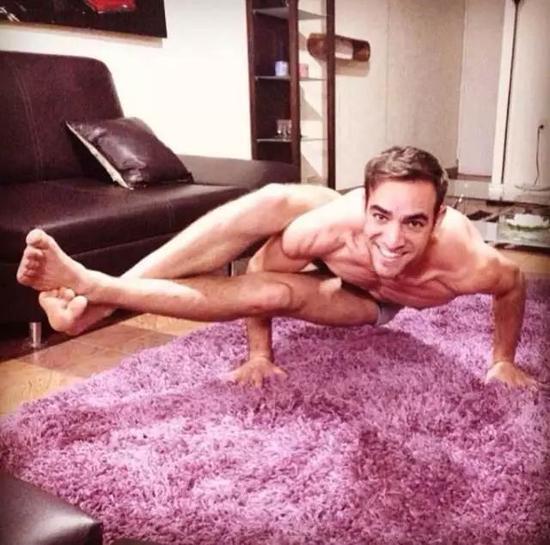
Around the same time, I turned to yoga, even though I'd always thought of myself as mentally driven rather than naturally athletic. I trained at a Bikram studio in Los Angeles, then advanced to a higher level of training in Mexico City — taught entirely in Spanish, a language I picked up specifically to be able to study there. I placed first in a Utah state yoga competition and fifth nationally. But behind those achievements sat something harder to talk about: the disorienting grief of stepping away from a career and a level of public recognition most people never experience and learning to live inside the quiet that followed it.
Hebrew Songs Through an Open Door
It was during that New York chapter — walking home one evening from my acupuncture studies — that I passed a building and heard something drifting out through an open door: Hebrew songs. I hadn't planned to go in. I just did.
The building was a Kabbalah Center, and what I found inside wasn't a religion in the traditional sense, but a mystical philosophy built around the relationship between light — divine energy — and the vessel meant to receive it. I noticed almost immediately that the Tree of Life at the center of Kabbalistic teaching, ten interconnected points, echoed the ten Heavenly Stems I'd just spent years studying in Chinese medicine. Two ancient systems, built continents apart, somehow speaking a strikingly similar structural language.
For someone raised on Mormon scripture, fluent in Mandarin, and now studying the human body through a Chinese philosophical lens, Kabbalah became one more language to learn — and, like the others, one that felt oddly familiar rather than foreign. It also gave me something my upbringing had struggled to provide: a community where the parts of my identity I'd spent over a decade reconciling weren't treated as a contradiction to faith. They were just who I was.
Recognition, Not Luck
That community is also where I met my fiancé, during a meal celebrating Sukkot at the Kabbalah Center. I don't really describe our meeting as luck. It felt more like recognition — two people who'd each done their own quiet work arriving, almost inevitably, in the same place at the same time. Our relationship grew alongside our shared participation in Jewish holidays — Purim, Passover, Hanukkah, Sukkot — each one deepening a bond I think about in spiritual terms as much as romantic ones.
My parents showed up for that relationship the way they'd shown up for nearly everything else in my life — with love that took its time but never wavered. I'll be honest that my mother's acceptance didn't arrive instantly; it came after real spiritual wrestling on her part. I don't hold that against her. I've come to see it as part of what real love looks like in a family still working things out — patience extended in both directions, and a trust that everyone eventually arrives.
All the Pieces, One Voice
Today, approaching forty, I run two organizations born out of the very intersections that have defined my life: one focused on Torah literacy across English, Chinese, and Hebrew, and another teaching the language of Chinese medicine to the practitioners who need it most. I still credit vision over luck — the belief that you build the door yourself when one doesn't already exist for you.
It's about a man who kept learning new languages, literal and otherwise, and discovered that fluency in one never required abandoning another — only the willingness to keep translating, for as long as it takes, until all the pieces of a life finally speak as one voice.